13 November 2010

Trip to Indonesia, Part 6: The Botanical Gardens at Bogor

We decided to make use of the weekend and experience Indonesia outside of Jakarta, so some of the school's administrators took us out to a city called Bogor. Like everywhere else we go in Indonesia, we were taken their by our dedicated driver. All westerners in Jakarta, and seemingly most middle-class or wealthier individuals here, have their own full time driver, which goes along with the general trend here of having multiple assistants, but I will go into that in a future post.

A rice paddy along the highway.

Bogor is about an hour and a half drive from Jakarta on the highway. Unlike the normal roads in Jakarta, the toll highways are very reminiscent of highways in the western world, with cars travelling fast, and few motorcycles. If it were not for the rice paddies and jungle environment, it would be easy to think you were in the US while driving along them.

Administration building of the botanical gardens.


Map of the gardens, with the presidential palace in the green area.


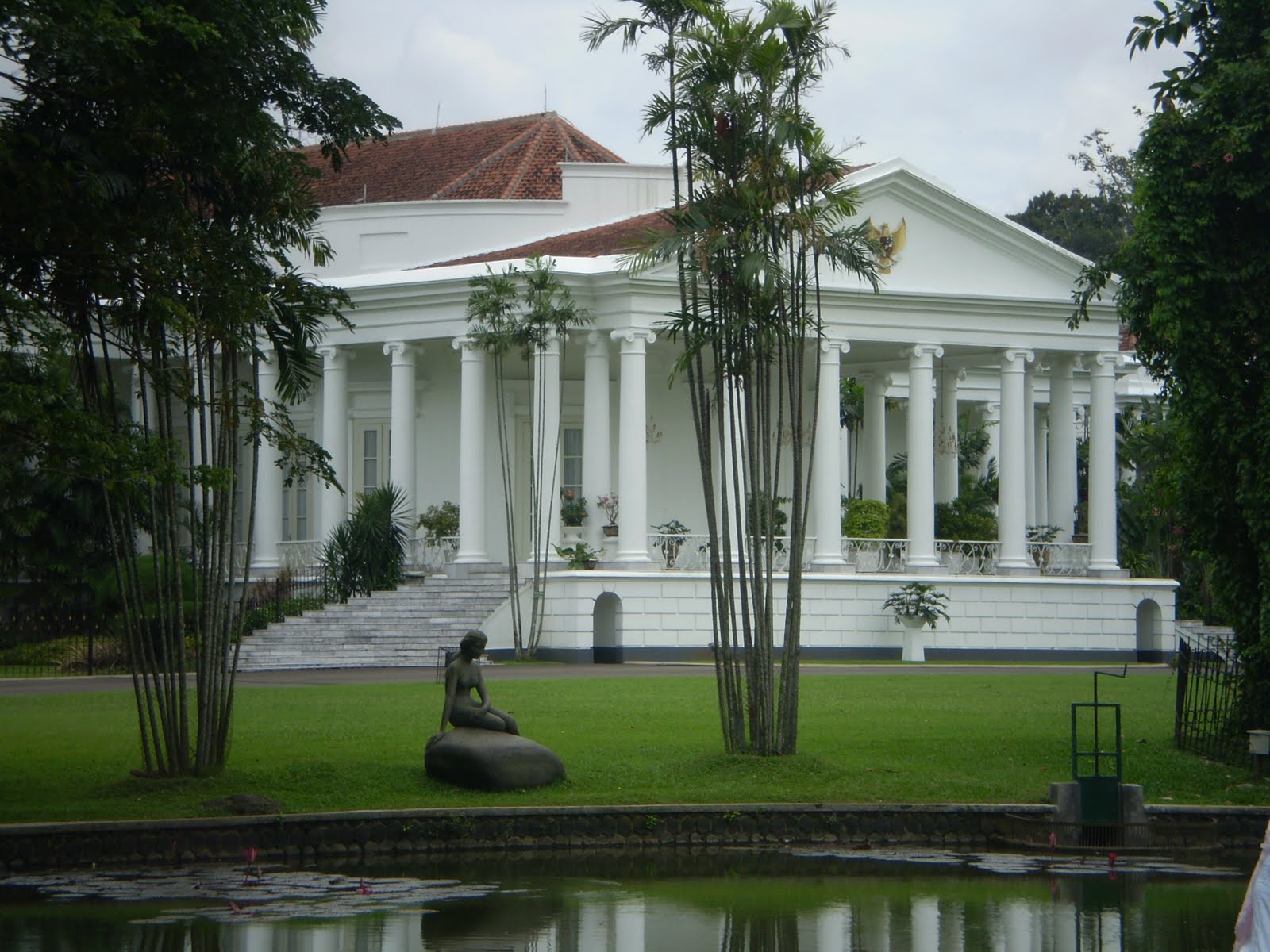
When we got to Bogor, we hired a tour guide to take us on a tour of the botanical gardens, which is also home to the Indonesian president's palace. The palace grounds are home to a herd of deer, apparently the descendants of a pair of deer gifted to Indonesia by Gandhi. The area immediately around the palace is also home to a collection of replicas of famous statues from Europe.

Replica of the famous Little Mermaid statue from Copenhagen, in front of the presidential palace.

Me in front of the presidential palace, complete with deer in the background.

Replica of a Swedish statue in front of the presidential palace.


Our tour of the gardens took us past a huge collection of exotic trees, flowers, and other plants, including some of the tallest bamboo I have ever seen. The gardens are incredibly beautiful and a world away from the hustle, pollution, and crowds of Jakarta.

A huge, hundred-year-old tree. They call these trees the redwoods of Indonesia because of how big they get.

Gardens in the park.

"Sausage fruit" trees.

The biggest spider I have ever seen, weaving its web. The spider was easily the size of my fist.

Flowers in the garden.

A plant which the locals literally use as umbrellas.

Some local university students who were learning English, politely asked us if they could interview us for a project. We all helped them out, answering their questions about America and which movie stars we liked the best. Not half an hour later, another group of students also approached us, and we gave another interview on camera. In some English class in Bogor, I am going to be famous!

One of the themed gardens at the park.


At the end of our trek around the gardens, we relaxed in a cafe and drank delicious fruit juices. I had an amazing avocado juice, which of course reminded me of avocado milkshakes, my favorite (though hard-to-find) milkshake flavor. Well prepared fruit juices here seem to have the same place in the culture that cocktails do in western culture, probably due to the fact that most Muslims don't drink hard liquor.

Park around the cafe in the botanical gardens.
Real coconut drink that my coworker drank.
My delicious avocado juice with coffee syrup.

Trip to Indonesia, Part 5: Slums of Jakarta

Today, along with a group of students at the school I am here with, I visited Bintaro Lama, a slum in Jakarta. The students learned about how the people there are learning to filter their water to make it drinkable. They also learned how important it is to conserve water. My coworkers and I were invited to join the students and observe. There are multiple international aid agencies working in the slums to teach the residents how to properly dispose of waste, filter their water, and use proper hygiene to reduce the spread of disease.

International aid workers demonstrate how to filter water using special silver-lined ceramic pots.
Rain water is captured from the roof of the latrine, which they later filter for drinking.
They leave plastic bottles in the sun to sterilize their water.

The people in the slum live literally in the middle of a trash dump. There is no official trash collection in Jakarta, so people dump their trash wherever they can. The people there sort through the trash, looking for valuable things and recyclable materials as a (meager) source of income. Trash that doesn't end up here seems to just end up in piles or is just burnt, which accounts for the constant smell of burning trash here in Jakarta.

The students talking with aid workers.


A gas-powered motor pumping water out of the ground, which is later filtered.

The "canal" running through the middle of the slum. Aid workers said the water is so dirty in the canal that they can't even filter it.

A view across the canal.

Though hard to see here, they use old tires to hold down the sheet metal on their roofs.

Behind each latrine is an artificial wetland created by aid workers to help break down the waste.

09 November 2010

Trip to Indonesia, Part 4: The Streets of Jakarta

Jakarta has a nickname among foreigners, "The Big Durian," referring to the asian fruit that has a sweet taste, but a not-so-pleasant smell. Jakarta lives up to its nickname well. Everywhere in the city, whether indoors or out, has a distinctive smell that's a mixture of burning trash and exhaust fumes.

Traffic

The pervasive exhaust fume smell is a consequence of the traffic in Jakarta, which is legendary. The city lacks any real mass transit, so motorcycles, bikes, and cars are the only way to get around for most people. There are almost no sidewalks, so walking is almost never an option.

Motorcycles are pervasive on the streets.

Whichever method of travel you choose, it is an adventure. Every type of traffic shares the road, and because there are very few traffic signals, every intersection becomes a free-for-all, though it is surprising how easily the locals navigate the chaos. Pedestrians run across the road, dodging cars and weaving through fast-moving motorcycles. Motorcyclists themselves weave through traffic, driving off the road frequently to pass gridlocked cars.

Pedestrians crossing the road.

One of the auto-rickshaws, called bajaj.

Despite all this, there is a vibrant street life, with vendors everywhere selling fruit, cigarettes, and random goods right along the side of the road. Each vendor seems to be a neighborhood attraction, with people gathered around each one, smoking and chatting.

A video of a common street scene, which I recorded earlier today:

08 November 2010

Trip to Indonesia, Part 3: Arrival in Jakarta

After a pleasant airline-funded breakfast at my airline-funded hotel in Singapore, I found out that the ash had cleared away from Jakarta, making it safe to fly again. I called Singapore Airlines, and within a few hours, I was on a short flight to Jakarta.

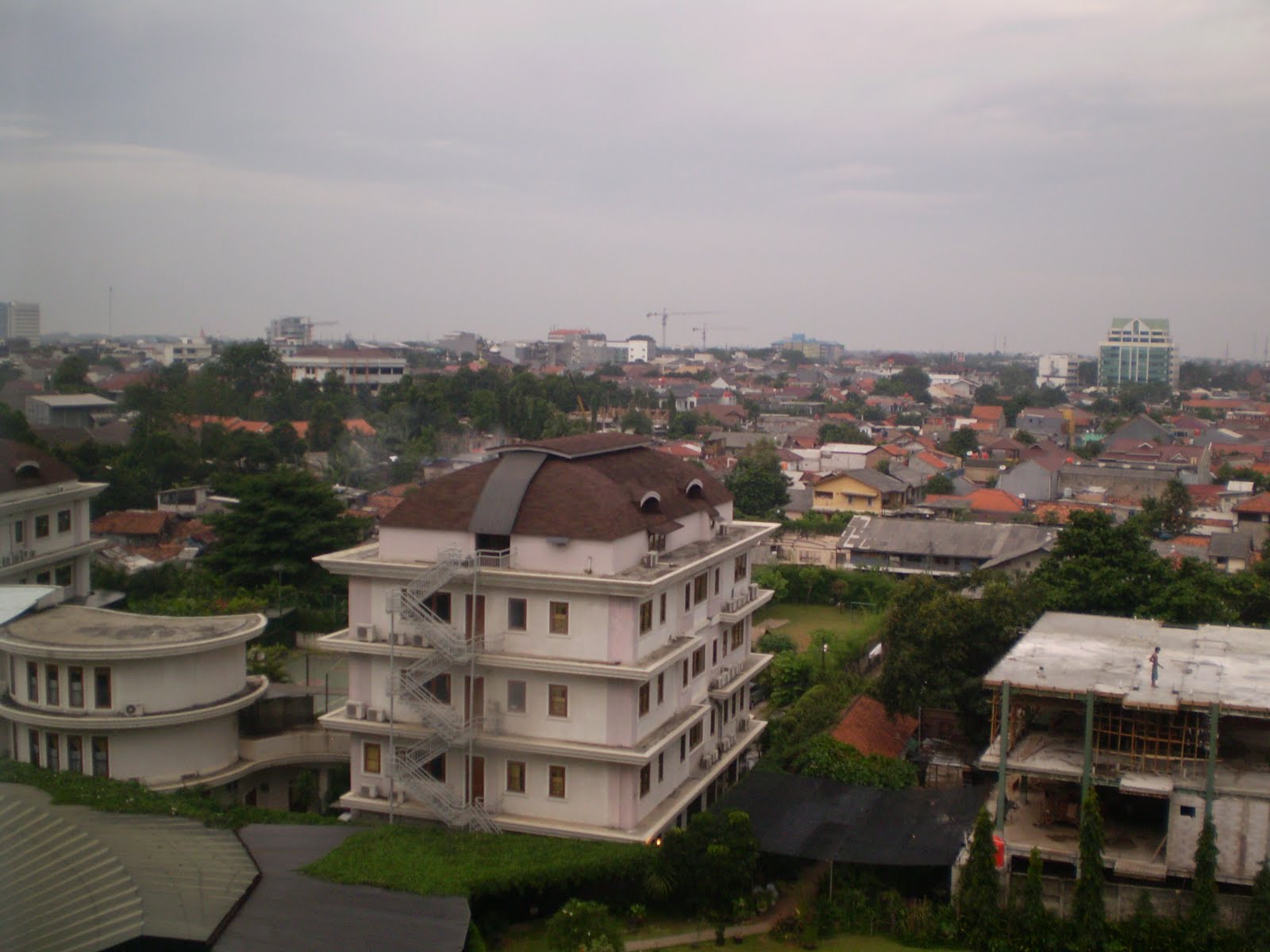
The area around my hotel

Stepping off the plane, the contrast between Singapore and Jakarta is immediately apparent. Singapore is the model of control, organization, and efficiency. The lines in the airport are well organized in Singapore, while in Jakarta, it is kind of a free-for-all. This seems to apply to almost every aspect of the two cities.

More of the city from my hotel window

From the airport, our client arranged a taxi for me to get to my hotel. The taxi ride took about an hour and a half, and amazingly cost just about $20. Travelling on the road in Jakarta is slightly terrifying. Besides the highways, every road seems to be one and a half lanes wide, and the streets are a mixture of cars, three-wheeled taxis, motorcycles, and pedestrians, all just barely managing not to run into each other. Most buildings are built immediately up against the street, and since there are no sidewalks, pedestrians are forced to walk on the road, fighting with vehicles for their share.

Gardens on the hotel property.

 My hotel is nice, although it is hard to compare with the hotel in Singapore. My room has a kitchen, a small living room with a couch and flat-screen TV, and a comfortable bed, so it has everything I need to be comfortable. On the hotel property is a pool with swim-up bar, and the hotel features three restaurants and a convenience shop.

The hotel pool, with swim-up bar

My hotel room's living area.

My hotel room's sleeping area.

My hotel room's kitchen.

06 November 2010

Trip to Indonesia, Part 2: Still in Singapore

The plan was to fly from Singapore to Jakarta this afternoon. All was going according to plan, but then this happened:
Mt. Merapi, Indonesia [picture not by me]
Just like Eyafjällajökull (no joking, I actually remembered how to spell that) shut down travel in Europe a few months ago, clouds of ash from the erupting Mt. Merapi has cancelled flights to and from Jakarta, leaving me and my coworkers stranded in Singapore indefinitely. Singapore Airlines, an airline which I can't say enough good things about, offered to put me up in a hotel in Singapore until the ash above Jakarta literally blows over. Not only that, but they paid for my gourmet dinner at my fancy boutique hotel.

My boutique hotel room in Singapore

The very nice bathroom
After dinner, I wandered around the neighborhood by foot. Singapore is a beautiful city/country. The entire place seems to be the perfect mixture of urban landscape and gardens. Everywhere you look are beautiful flowers, picturesque trees, and well-maintained high-rises. My wanderings were cut short by a sudden downpour that would have left me drenched if I hadn't happened to circle back to the hotel at just the right time.
Singapore from my taxi from the airport
More of Singapore's skyline

Hopefully, the ash will blow over tomorrow and I can get to Jakarta then. If not, I can think of worse places of being stuck than this island paradise.

Trip to Indonesia, Part 1: At Singapore's Airport

Before you do it, it is hard to imagine how long 18 hours on an airplane really is. I left San Francisco on Thursday afternoon on my way to Jakarta, Indonesia for a business trip, and by the time I reached my connection in Singapore, it was early morning on Saturday.

Orchid garden at Singapore's airport

Fern garden at Singapore's airport

Singapore Airlines has made this trip as pleasant as could be expected. They provide unlimited free movies on the flights, plus good meals, free beer and wine, and excellent customer service. I took full advantage of the free movies, and watched "Salt", "Knight and Day", "Killers", "Eclipse", "Dinner For Schmucks", and "L'Amour, c'est mieux a deux" ("The Perfect Date"). I started watching "Flickan som lekte med elden" ("The Girl Who Played With Fire"), but the sound cut out after 20 minutes, so I couldn't finish that.

Singaporean musicians playing at a cultural demonstration at the airport

When I finally arrived in Singapore, I stayed at a simple, but comfortable hotel in the airport, the Ambassador Transit Hotel. The funniest thing about the hotel was that everything at the hotel, including their logo, is written in Comic Sans. Singapore's airport is huge and really nice, complete with a movie theatre, video games, more restaurants than you can imagine, and best of all, free wifi, where I am writing this now. In a few hours, I head out to Jakarta, but until then, time to enjoy the airport!

Airport koi pond


24 April 2010

Expert Language Learning Techniques

Technique #1: 10,000 Sentences

Use computer-based flashcards to learn vocabulary and grammar. But instead of memorizing individual words, memorize entire sentences. The goal is to memorize 10,000 sentences, hence it is called the 10,000 Sentences Method. By learning entire sentences, recall is improved and you learn words in context so you can use them later.

Finding Sentences

You need places to find sentences. Look for sentences in any place you experience the language: film subtitles, books, news websites, etc.

Creating Good Flashcards

It's important to learn how to choose good sentences to make your flashcards. See Making Sentence Items (Antimoon.com) for simple advice on how to do this.

Flashcard Software

Use a computer program which uses a spaced repetition algorithm.  Spaced repetition software ensures that you see each card at the right time to help you remember it most efficiently. Any spaced repetition system will do, but I use Anki. Anki is a great program that is cross-platform and supports synchronization over the internet.

Tips for Studying
Additional Information
Technique #2: Shadowing

Use Assimil, Linguaphone, or a similar course. See Professor Alexander Arguelles' Foreign Language Study.

Technique #3: Scriptorium

Use Assimil, Linguaphone, or a similar course. See Professor Alexander Arguelles' Foreign Language Study.

Technique #4: Listening-Reading Method

Listen to an audio recording of a book while simultaneously reading the text of the recording aloud. Optimally, you will also have a translation of the text to refer back to immediately.  Even better, is to have the texts in parallel.

Materials needed:
  • Audio recording in target language (L2) of a book (novels are best)
  • Text of the book in L2
  • Text of the book in L1 (a translation from L2)
Steps:
  1. Read the L1 text. This ensures that you understand the story.
  2. Listen to the L2 audio while reading the L2 text.  This gets you used to the speed of talking and helps you learn to hear the word boundaries
  3. Read the L1 text while listening to the L2 audio. Refer back to L2 text when necessary.  Do this from the beginning to the end of the story three times.  This is where learning takes place.
  4. Repeat after the recording as many times as necessary to become fluent.
  5. Translate the L1 text to L2 in writing... use the L2 text to crosscheck your work.
Additional Information:
Technique #5: Positive Reinforcement

Keep a log of all your language studies and award yourself points for studying every day and deduct points when you miss studying for a day. When you reach a certain number of points, you can reward yourself by buying an album of music in the language you are learning, a book in your language, or something else fun that is related to your language.

Technique #6: Cultural Immersion

Sources:
  • Podcasts and Radio
  • Television and Online Video
  • Books
  • Monolingual Dictionaries
  • Websites (Gmail, Facebook, etc.)
  • News
Additional Information:
  • Khatzumoto is the king at cultural immersion. He learned Japanese fluently in a year by completely immersing himself in everything Japanese: film, video games, books, television, the internet, and more. His website is full of great advice: Guide to All Japanese All The Time.

12 March 2010

Review: "Say Uncle", by Kay Ryan

I bought my copy of "Say Uncle" last year when Kay Ryan came to San Francisco and gave a talk on her work. When I saw her speak, I had never really heard of her before, but left the talk totally impressed by both her work and her personality.

This book contains dozens of very short, but very poignant poems. She approaches topics from everyday life, but frequently through an almost scientific detachment. She totally removes herself from the poems and makes them universally appealing. She is the ultimate observer, able to comment on the topics in the poems without bringing preconceived notions about that topic, which lets the reader see each thing anew.

Ryan uses a technique she calls "recombinant rhyme", in reference to how the DNA of two different individuals or even species can be combined to create a chimera, or hybrid. She does a similar thing with words and parts of words, and while her poetry has little perfect rhyme, the same or similar sounds are found sprinkled around the poem, combined together to make new words. With all this "recombination", slant rhyme and other imperfect rhymes are very common. Her verse is fairly free, though there are still times when the reader can start to fall into a metrical pattern, only to immediately be derailed by an extra word or phrase. When I heard her talk about her work, Ryan said that she intentionally avoids overly metrical lines.

I wonder if these types of poems are perfect for the Twitter Age: short, witty poems that can be digested quickly but lead the reader to frequent "Ah ha!" moments. Interestingly, the common expression "say uncle" which is the title of this book, apparently comes from a British joke about a parrot (See World Wide Words: Say (or cry) uncle)

Suggested Reading:

26 February 2010

Finding Science-Based Answers to Health Questions

When someone has a health-related question today, they are most likely to do a Google search for their symptoms. Of course, what they are looking for is good advice on what will help them. But the results they get back will be a mixture of actual good advice mixed with con-men and quacks selling snake-oil cures. How can a person who wants to find reliable advice sift through all the mountains of useless information?

The key to finding good health advice is to seek advice that is supported by good scientific research, which can be difficult if you are not sure where to look. Here are the resources that I use when trying to find health advice:
Science-Based Medicine
Blog that covers all topics related to science and health. Posts on the site are written by a staff of ten physicians and researchers in various medical fields. They also provide a topic-based reference guide to direct you to information on different topics.
The Cochrane Collaboration
Systematic reviews of evidence-based health therapies and products. Use the search function to find evidence about your particular interest.
Quack Watch
A guide to fraudulent health products, services, and theories. Includes articles on quackery in medicine in general and how to identify it.
PubMed
Search the scientific medical literature directly. This site is a little more technical, but you can find information on the individual papers that support or contradict various health claims.
The above links are good general resources. In addition, here are a few random interesting sites:
Snake-Oil Supplements
A graphic showing which supplements are supported by evidence. Not a general reference, but a quick guide to get you started.

01 December 2009

Intelligence Squared Debate: Is Atheism the New Fundamentalism?

This is a good debate regarding the "New Atheism" promoted by the current prominent atheist writers such as Richard Dawkins and Christopher Hitchens. Is their particular brand of atheism somehow fundamentalist?

The video has multiple parts:


Link to Video